
The Illusion of Competence in the Age of AI

In a book I am currently reading, a study developed in 1960 by three professors at New York University is presented again. They developed a model that was destined to become one of the best-known references in learning processes: the four stages of competence model.
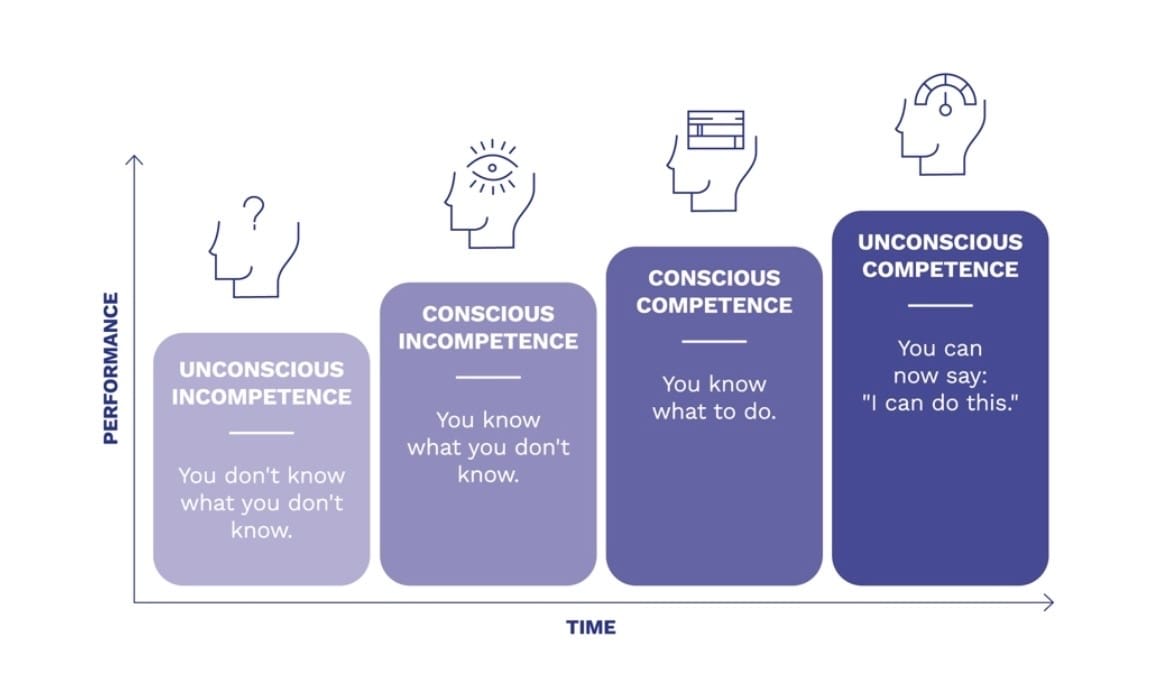
The analysis of this learning process sparked a reflection in me.
Is this model still valid with the advent of AI? The answer is certainly yes. But what needs to change in our approach to learning, now that we have essentially become used to skipping the entire phase of identifying sources, comparing information, detecting errors, and reworking concepts?
Arriving at an answer so quickly leads us to believe that we know, to believe that the information is correct and ready to be used. It prevents us from going through the complete process that allows us to develop and build the mental connections needed to reach unconscious competence.
Often, if we have to face the same problem twice, we prefer to ask our agent for a new answer, because we have not made that knowledge our own — and it is faster than we are, even at finding it in our past work.
Knowing where to find an answer does not mean knowing!
Since most of us are lazy, we can say that the more AI makes it easy to obtain answers, the harder it becomes to develop deep skills.
So how can we reach “unconscious competence” in the age of AI?
Skipping the second stage is the greatest risk, because that is where we introduce critical thinking.
Therefore, we need to use AI differently. AI must not replace us; it must be an accelerator, a kind of tutor.
Let’s stop asking for the answer and instead ask it for the sources. Let’s develop the reasoning ourselves and engage with it to understand what else we can add, or what we may have misinterpreted and why. And let’s always ask for the sources behind the reasoning, so that we can read them, verify them, and critically analyze them.
In short, the answer is easy, but it is not enough. We need to live the experience of learning and voluntarily reintroduce effort.
In the twentieth century, value lay in possessing information.
Today, information is ubiquitous.
Value is shifting toward interpretive ability, discernment, creativity, and the ability to connect concepts.
True human competence may become precisely what cannot be immediately automated, such as intuition, judgment, ethics, experience, relational ability, and systems thinking.
In short… today more than ever, we need to make our own the famous phrase Steve Jobs pronounced at Stanford University in 2005:
“Stay hungry, stay foolish.”